
Introductory guide · Practical guide
Introduction: The digital identity revolution
In 2014, Estonia launched e-Residency, the world’s first government-issued digital identity for global entrepreneurs. Since then:
125,000+ e-residents from 170+ countries, 35,500+ Estonian companies established, €15 billion+ in total company turnover, ~1,100 new e‑Residency applications monthly. Source: E-Residency statistics.
The message is clear: secure, portable digital identity isn’t just a public-sector innovation. It’s a catalyst for global business growth.
But as digital entrepreneurship expands, what’s next for digital ID? And how are technologies like blockchain ID, the EU Digital Identity Wallet, and self-sovereign identity (SSI) reshaping the rules?
At 1Office, we help founders navigate these shifts every day. Let’s dive into the latest developments and their impact on global entrepreneurship.
The power of Estonia’s e-residency
Estonia’s e-Residency enables non-residents to start and manage EU-based businesses fully online, without ever setting foot in the country. It has become indispensable for digital nomads, SaaS founders, consultants, and scale-up entrepreneurs.
Key benefits:
- Secure authentication with government-issued digital ID
- Legally binding digital signatures for contracts and official documents
- Full access to the EU single market for borderless business operations
- Remote company formation in under 24 hours
As of 2025: Over 35,500 active Estonian companies are run by e-residents. Nearly 50% of new e-Residency companies serve global B2B & SaaS markets. €2 billion+ annually generated in export services.
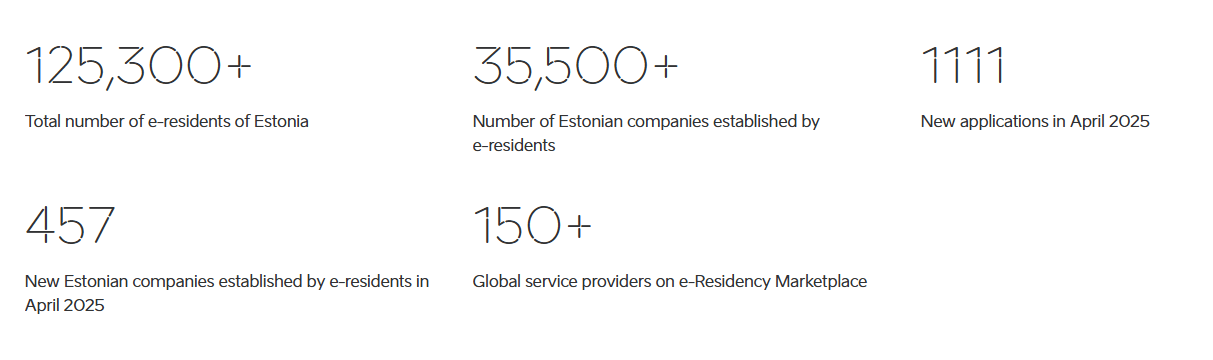 Estonia’s e-Residency latest statistics. Source: E-Residency
Comparison: While Estonia’s e-Residency is pioneering digital ID for entrepreneurs, other nations are following suit:
- Lithuania’s e-Residency lacks remote company registration & banking access.
- Portugal is testinga blockchain identity system for startups.
- UAE and Singapore are integrating AI-driven identity verification for global business.
Other digital ID innovations driving global business
Digital identity is becoming the backbone of cross-border entrepreneurship. Here are the most impactful developments on the horizon:
EU digital identity wallet (Coming by 2026)
A major EU-wide initiative allowing individuals and businesses to store, manage, and share credentials securely, from licenses and diplomas to business IDs, across borders.
Projected Impact:
- 80% of EU citizens are expected to adopt the wallet by 2030
- Enables seamless onboarding to banking, tax, and business systems
- Prioritizes privacy, security, and user control over personal data

Blockchain-based IDs & self-sovereign identity (SSI)
Blockchain-powered identity systems are gaining traction, offering decentralized and fraud-resistant identity verification that gives users control over their data.
Key Benefits:
- Reduces third-party verification costs by up to 90%
- Protects user data from centralized breaches
- Peer-to-peer trust model between entrepreneurs & institutions
Smart IDs & NFT-based verification
Digital identity is evolving into Smart IDs and NFT-linked credentials, enhancing portability and security.
Emerging use cases: Proof-of-incorporation NFTs for verifiable company registration. Smart contracts with embedded identity logic for secure transactions. Decentralized KYC processes for fintech platforms.
Future outlook: What’s next?
EU-Level Initiatives
The European Digital Identity Framework aims for 100% adoption of secure digital ID solutions by 2030. Ensure full interoperability of IDs between countries and platforms. Establish a legal framework supporting cross-border business operations.
Blockchain’s expanding role
- Frictionless ID verification across borders
- Privacy-preserving identity storage using zero-knowledge proofs
- Enhanced user control over personal & business data
Regulatory Challenges
The biggest barrier to seamless digital ID adoption is the lack of global standards for identity interoperability. In addition, there are varying legal definitions of digital ID and e-signatures and privacy concerns with GDPR compliance for blockchain-based identity. However, governments are rapidly closing these gaps, with frameworks like eIDAS 2.0 setting unified standards for secure digital authentication.
What founders & entrepreneurs should know
E-Residency is just the beginning. New digital ID systems will enable faster, cheaper, & more secure ways to operate global businesses. Blockchain identity will reshape trust. Decentralized IDs are giving founders more control over verification processes. EU initiatives will set the pace. Entrepreneurs working in or targeting the EU should follow eIDAS 2.0, the EU Digital Wallet, and cross-border e-government policies.
Want to stay ahead in the age of digital identity?
For guidance specific to your company, speak with the UK team.